Understanding the Car Alternator
Every time you turn the key in your ignition‚ you’re initiating a complex dance of mechanical and electrical systems that bring your vehicle to life. While the battery often gets the credit for starting the engine‚ another crucial component works tirelessly behind the scenes to keep everything powered once you’re on the road. This indispensable device‚ the car alternator‚ is responsible for generating the electrical energy required to run your vehicle’s numerous systems. From lighting your path to charging your phone‚ the alternator ensures a steady supply of power‚ making it a true workhorse in your automotive setup.
Understanding the Core Function of a Car Alternator
At its heart‚ the alternator’s primary function is to convert mechanical energy from the engine into electrical energy. This constant supply of electricity is vital for the operation of virtually every component in your car’s electrical system.
Generating Vital Electrical Power for Your Vehicle
Once your engine starts‚ the alternator takes over from the battery as the main source of electrical power. It produces alternating current (AC) through electromagnetic induction‚ which is then converted into direct current (DC) by a built-in rectifier. This DC current is what all your car’s systems utilize‚ ensuring consistent voltage for optimal performance.
Sustaining Your Car Battery’s Charge
While the battery provides the initial surge of power to start the engine‚ the alternator’s role is to replenish the battery’s charge. After ignition‚ the battery’s energy levels drop slightly. The alternator continuously recharges the battery‚ keeping it at an optimal level so it’s ready for the next start. This prevents the battery from draining completely while the engine is running.
Supplying Power to All Automotive Accessories
Modern vehicles are packed with electrical components‚ from essential safety features to comfort-enhancing accessories. The car alternator powers them all. This includes your headlights‚ tail lights‚ interior lights‚ radio‚ air conditioning‚ power windows‚ windshield wipers‚ dashboard instruments‚ and the engine’s electronic control unit (ECU). Without a functioning alternator‚ these systems would quickly deplete the battery and cease to operate.
The Inner Workings: How a Car Alternator Operates
The operation of an alternator is a sophisticated process‚ harnessing the principles of electromagnetism to create electricity. Here’s a simplified breakdown of the stages involved:
- Engine Rotation: The engine’s crankshaft drives a serpentine belt‚ which in turn spins the alternator’s pulley.
- Rotor Spin: The spinning pulley causes the alternator’s rotor‚ an electromagnet‚ to rotate rapidly inside the stator.
- Magnetic Field Generation: As the rotor spins‚ it creates a moving magnetic field.
- Current Induction: The moving magnetic field passes through the stationary coils of wire in the stator‚ inducing an alternating current (AC) within them.
- Rectification: A set of diodes within the rectifier assembly converts this AC power into direct current (DC) that the car’s electrical system can use.
- Voltage Regulation: A voltage regulator monitors the system’s electrical needs and controls the alternator’s output‚ ensuring a stable voltage (typically around 13.5 to 14.5 volts) to prevent overcharging or undercharging.
Key Components of an Alternator
Understanding the vital parts helps clarify the alternator’s complex role:
| Component | Function |
|---|---|
| Rotor | The rotating electromagnet that creates a magnetic field when energized. |
| Stator | A stationary set of copper wire coils where AC current is induced by the rotor’s magnetic field. |
| Rectifier | A bridge of diodes that converts the alternating current (AC) generated by the stator into direct current (DC). |
| Voltage Regulator | An electronic circuit that controls the alternator’s output voltage‚ preventing overcharging and ensuring stable power delivery; |
| Brushes | Carbon contacts that conduct current to the rotor windings‚ enabling the creation of the magnetic field. |
| Pulley | Connected to the engine’s serpentine belt‚ it drives the rotor’s rotation. |
Recognizing Signs of a Failing Car Alternator System
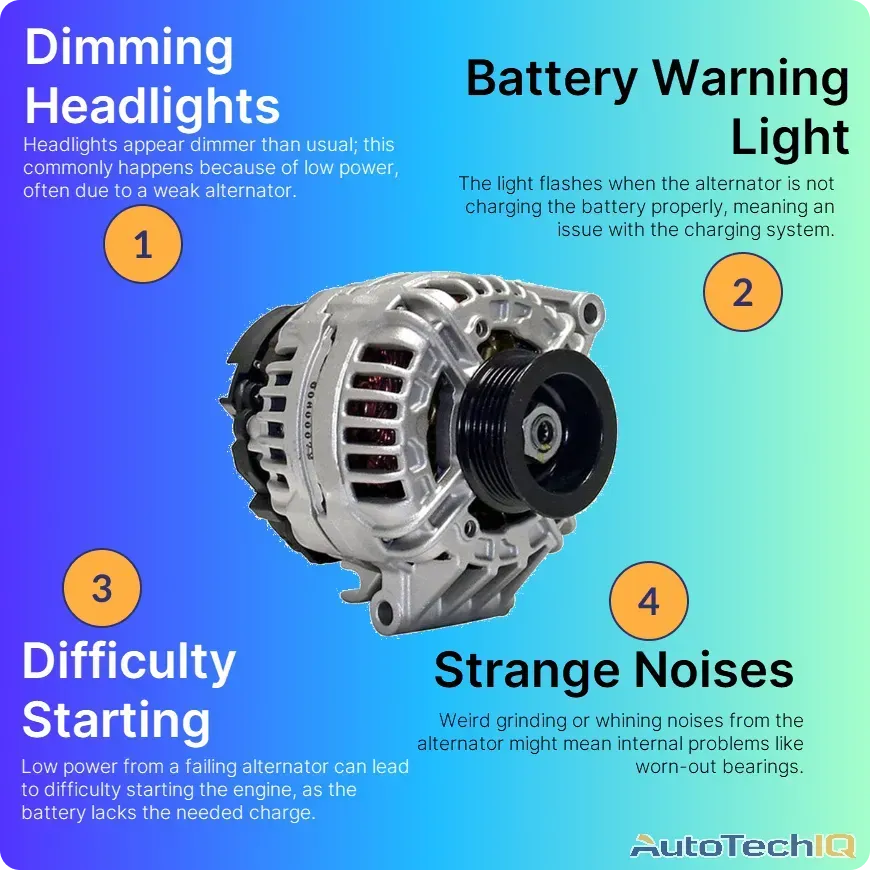
Because the alternator is so critical to your vehicle’s operation‚ it’s important to recognize the signs that it might be failing. Ignoring these warnings can lead to a dead battery and leave you stranded. Common symptoms include:
- Dimming or Flickering Lights: Headlights‚ dashboard lights‚ or interior lights may appear dimmer than usual or flicker inconsistently.
- Battery Warning Light: The battery shaped icon on your dashboard often illuminates when the alternator is not properly charging the battery.
- Trouble Starting or Frequent Stalling: A weak or dead battery‚ due to a non-charging alternator‚ will make starting difficult or cause the engine to stall.
- Strange Noises: A grinding or whining noise coming from under the hood can indicate worn bearings within the alternator.
- Electrical Accessory Malfunctions: Power windows may operate slowly‚ the radio might cut out‚ or other electrical components may behave erratically.
- Burning Rubber Smell: This could indicate a slipping or overheating serpentine belt‚ which drives the alternator.
Frequently Asked Questions About Your Car’s Alternator
Here are some common questions drivers have regarding their car’s charging system:
Q: Can a car run without an alternator?
A: A car can run for a short period without a functional alternator‚ but only until the battery’s charge is depleted. Since the alternator is responsible for continuously supplying power and recharging the battery‚ the vehicle will eventually lose all electrical power and stop running once the battery dies.
Q: How long does a car alternator typically last?
A: The lifespan of a car alternator can vary significantly depending on the vehicle‚ driving conditions‚ and quality of the component. On average‚ an alternator is designed to last between 5 and 8 years‚ or roughly 100‚000 to 150‚000 miles. However‚ some can fail earlier‚ while others may last much longer.
Write a quality, in-depth, magazine-style article on the topic:
Write in English
Use a clickbait and catchy headline. Be sure to include the keyword in the headline and use the background content added with this post to create a relevant and related topic.
Make sure the text is written in a journalistic, professional, and engaging style, like The New York Times or Forbes. The tone should be optimistic, forward-looking, and persuasive. Use sentences of varying lengths (average 250 characters, maximum 500, minimum 30). Use appropriate analogies, descriptive adverbs (e.g., “incredibly effective”), and correct adverbial phrases (e.g., “By integrating insights from AI…”). Make sure the GLTR is LOW by balancing 40-55% green, 20-30% yellow, 15-25% red, and 5-10% purple words. Use present and past participles to add dynamism. Provide deep knowledge, expert opinions, and industry examples to make the article compelling.
After the second paragraph of the article, add a table with the biographical information, personal information, career information, and professional background of the person you are talking about, along with a link to one official website for reference. The table should be in a format that is easy to embed in WordPress.
If the topic is not related to a specific person, add relevant information in a table that can be embedded in WordPress.
Ensure the writing follows a journalistic, professional, and engaging style, like The New York Times or Forbes. The tone should be optimistic, forward-looking, and persuasive. Use varied sentence lengths (average 250 characters, max 500, min 30). Incorporate relatable analogies, descriptive adverbs (e.g., ‘remarkably effective’), and proper adverbial phrases (e.g., ‘By integrating AI-driven insights…’). Ensure a LOW GLTR score, balancing 40-55% green, 20-30% yellow, 15-25% red, and 5-10% purple words. Use present and past parts to enhance dynamism. Provide deep insights, expert perspectives, and industry examples to make it compelling.
After the second paragraph of the article add table with bio data and personal information, career, professional information of person in topic, also add link to one authentic website for reference, the table should be in the form that it can be easily inserted in wordpress.
If the topic is other than person related than add related information in the form of table that can be inserted in wordpress.
Q: Is it difficult to replace an alternator?
A: The difficulty of replacing an alternator depends heavily on the specific make and model of the car. In some vehicles‚ it’s easily accessible and can be a straightforward DIY job. In others‚ it may be buried deep within the engine bay‚ requiring extensive disassembly and specialized tools‚ making professional help advisable.
Q: What’s the difference between an alternator and a generator?
A: While both devices convert mechanical energy into electrical energy‚ the key difference lies in the type of current they produce and their internal design. Generators typically produce direct current (DC) directly‚ often using a commutator. Alternators‚ as their name suggests‚ produce alternating current (AC) and then use a rectifier to convert it to DC for automotive use. Alternators are generally more efficient‚ lighter‚ and more durable than older DC generators.
The car alternator is undeniably a cornerstone of your vehicle’s electrical health‚ performing far more than just a simple task. It continuously converts mechanical energy into the vital electricity that fuels every aspect of your driving experience‚ from essential engine functions to modern creature comforts; Understanding its role and recognizing the signs of potential failure can prevent inconvenient breakdowns and costly repairs. Regular maintenance and prompt attention to warning signs are crucial for ensuring the longevity and reliability of this critical component. Ultimately‚ the alternator stands as a testament to intelligent automotive engineering‚ diligently working to keep your journeys smooth and powered.
Author