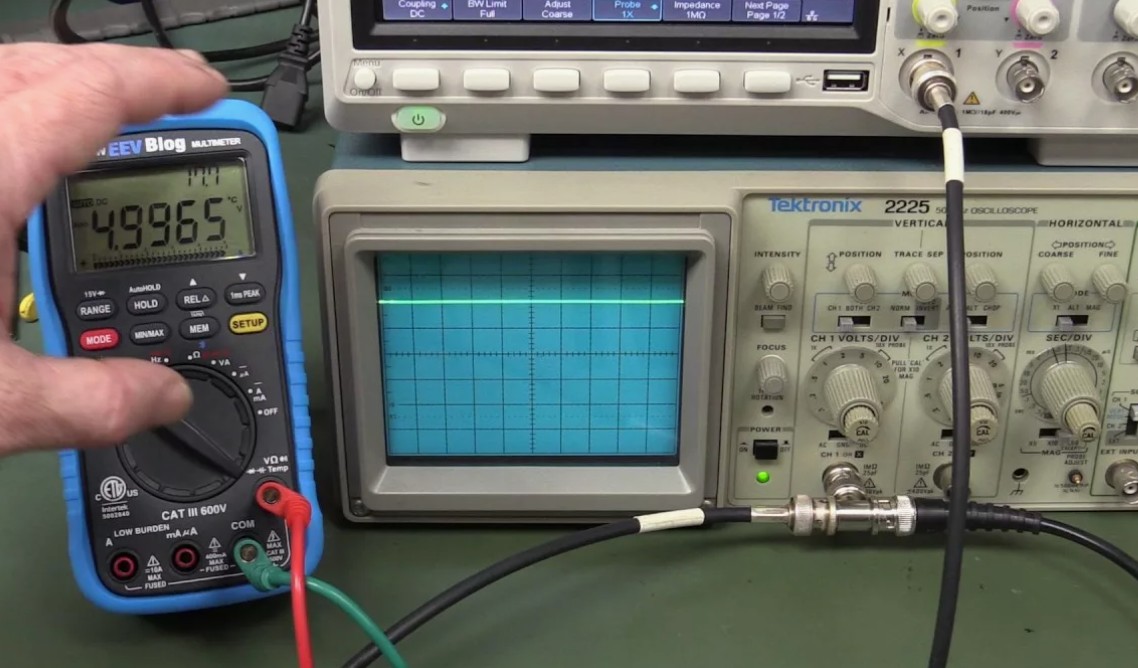
What Is an Oscilloscope and How Do You Use One?
An oscilloscope is a diagnostic tool used to visualise electrical signals over time. It displays voltage on the vertical axis and time on the horizontal axis, allowing engineers to analyse waveform behaviour, frequency, and signal integrity in real time.
What does an oscilloscope measure?
Oscilloscopes measure both voltage-based and time-based characteristics of electrical signals. This makes them essential for troubleshooting circuits and understanding how signals behave dynamically.
Key measurements include:
- Frequency and period of a signal
- Amplitude and peak-to-peak voltage
- Duty cycle (on vs off time)
- Rise and fall time
- Average and mean voltage
For a deeper technical overview, see Oscilloscope.
How does an oscilloscope work?
An oscilloscope converts electrical signals into a visual waveform. As voltage changes over time, the device plots this data onto a screen, allowing you to “see” the signal.
The display is divided into:
- Vertical axis representing voltage (volts per division)
- Horizontal axis representing time (seconds per division)
By adjusting these scales, you can zoom in on specific parts of a waveform or view longer signal patterns.
What are the main parts of an oscilloscope?
Most oscilloscopes share the same core components, each controlling how signals are displayed and analysed.
Display
The screen shows the waveform using a grid system. Each square represents a division used to measure voltage and time.
Vertical system
Controls voltage scaling. Adjusting volts per division lets you zoom in or out on signal amplitude.
Horizontal system
Controls time scaling. This determines how much of the signal is visible across the screen.
Trigger system
Stabilises the waveform by locking onto a specific point in the signal, preventing it from drifting across the display.
Probes
Probes connect the oscilloscope to the circuit. They carry the signal into the device and often include attenuation settings like 1X or 10X.
How do you use an oscilloscope step by step?
Using an oscilloscope follows a repeatable process, even though signals may vary.
Basic workflow:
- Select and connect your probe to the circuit
- Power on the oscilloscope
- Set voltage (V/div) and time (s/div) scales
- Adjust the trigger to stabilise the waveform
- Fine-tune position and zoom for clarity
- Measure waveform properties using built-in tools
This process allows you to isolate and analyse specific signal behaviours effectively.
When should you use an oscilloscope?
Oscilloscopes are used whenever signal behaviour over time matters. They are essential for debugging and analysis in electronics.
Common use cases:
- Diagnosing faulty circuits
- Measuring signal frequency and amplitude
- Detecting noise or interference
- Analysing waveform shapes (sine, square, etc.)
- Comparing multiple signals
What should you look for when buying an oscilloscope?
Choosing the right oscilloscope depends on your technical requirements and use case.
Important factors include:
- Bandwidth (how fast a signal it can measure)
- Sampling rate
- Number of channels
- Maximum input voltage
- Resolution and sensitivity
If you’re comparing options, this guide on https://electricalunits.com/electronics/best-100mhz-oscilloscopes-2026/ provides a useful breakdown of current models and capabilities.
Final Thoughts
An oscilloscope is one of the most powerful tools in electronics, turning invisible electrical signals into clear, measurable visuals. Once you understand the core controls and workflow, it becomes an essential part of diagnosing and improving any circuit.
Author